Paul O’Connor, himself now the published author of a nonfiction book, takes a look at the latest offering from a recent book by someone he deems “a master of narrative nonfiction.”
Reviewed by Paul T. O’Connor
LONDON FALLING: A MYSTERIOUS DEATH IN A GILDED CITY AND A FAMILY’S SEARCH FOR TRUTH. By Patrick Radden Keefe. Doubleday. 320 pages. $35, hardcover.
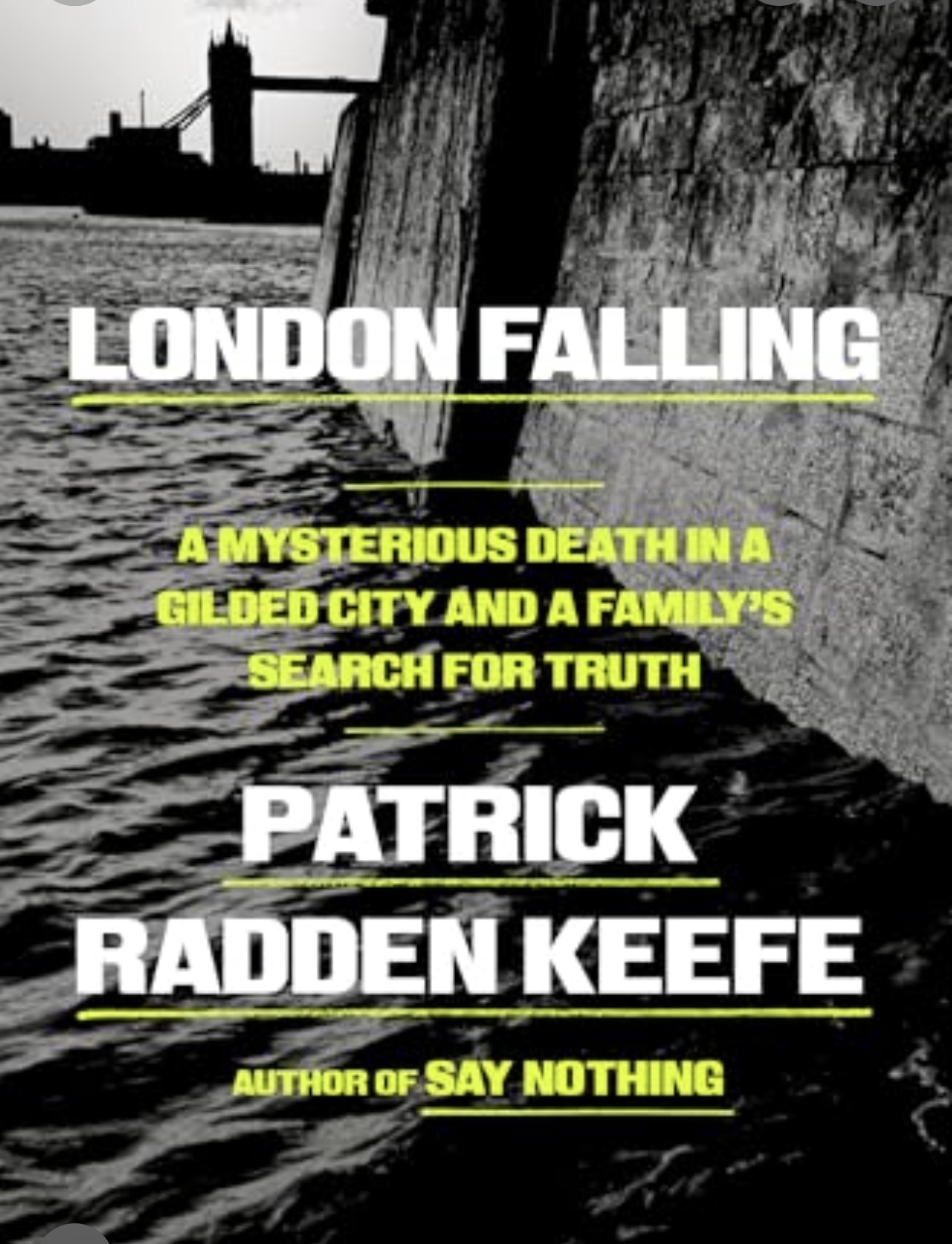
In his spectacular Say Nothing, Patrick Radden Keefe investigated the disappearance of an unknown widow and mother of 10 from a nondescript Catholic tenement in Belfast, Northern Ireland, and followed it to the point where the story exposed a crime with international political implications.
A master of narrative nonfiction writing, Keefe has done the same with London Falling.
In 2019, a middle-class 19-year-old died after falling from the balcony of a fifth-floor apartment and landing in the Thames River. CCTV captured the moment, and authorities assumed it to be a troubled youth’s suicide.
But Zac Brettler’s parents didn’t believe that their son had killed himself. Zac had set out on his own, was traveling in lofty social circles and appeared to be making a substantial amount of money in financial and real estate undertakings. A pair of successful businessmen had apparently recognized his talents and put him to work. At one point, the skeptical parents feared he was peddling drugs, but blood tests from a routine doctor’s visit came back perfectly clean.
The Brettlers began pursuing leads and learned that London’s famed Metropolitan Police Department was not what Masterpiece Theatre would have us believe. Police botched the investigation, and a coroner’s inquest was equally unsatisfying to the parents; it was a futile exercise of “Let’s get this over with.”
It was only in 2023 that they met Keefe and he began to follow up on the details they had found. It took him months, but he pulled together a damning story that he published in The New Yorker, and that was when the London tabloids first reported on Zac’s death.
London Falling is a story of conmen conning other conmen. It is a story that Keefe connects to Russian mobsters and South Asian swindlers. Once again, Keefe has taken what appears to be a run-of-the-mill death and tied it to much larger political and criminal forces.
This is not an easy read. The book starts fairly slowly as Keefe reports reams of background about Zac and his family. Sixty pages in, I was ready to take my copy back to the library, but I am so glad I resisted that impulse. He chased the stories of the two “successful businessmen” Zac had connected with and found that far from being successful, they were trying to make a score off of Zac.
That’s because Zac had somehow convinced a large number of London conmen that he was the son of, and heir to, a Russian oligarch’s fortune worth hundreds of millions of pounds. Even some legitimate businessmen fell for Zac’s con, none doing so much as minimal research into his story or asking him to say a few words in Russian.
The story would be hilarious if it were not so sad. I’m not sure the movie won’t be a comedy.
London is one of the world’s financial capitals, and after the fall of the Soviet Union, Russian oligarchs began stashing their plunder in the city. Ultimately, they corrupted the British financial system and inserted their corruption into the country’s political apparatus, too.
London Falling is more than the story of one young man’s death. Instead, it is the story of a world capital’s corruption by its newfound dependence on the wealth that plunderers brought to it. And it is all told through the story of Zac Brettler.
- Paul T. O’Connor is a retired newspaper journalist and college professor. His first book, The Missing Child: The Life She Lived and the Life She Missed, is being published by TorchFlame Books. Look for it in local North Carolina bookstores, or order online.