Last November was the 50th anniversary of a famous shipwreck you may be aware of because of a popular song. Paul O’Connor reviews a book written to mark that anniversary and tell more of the story of the doomed ship, the Edmund Fitzgerald.
Reviewed by Paul T. O’Connor
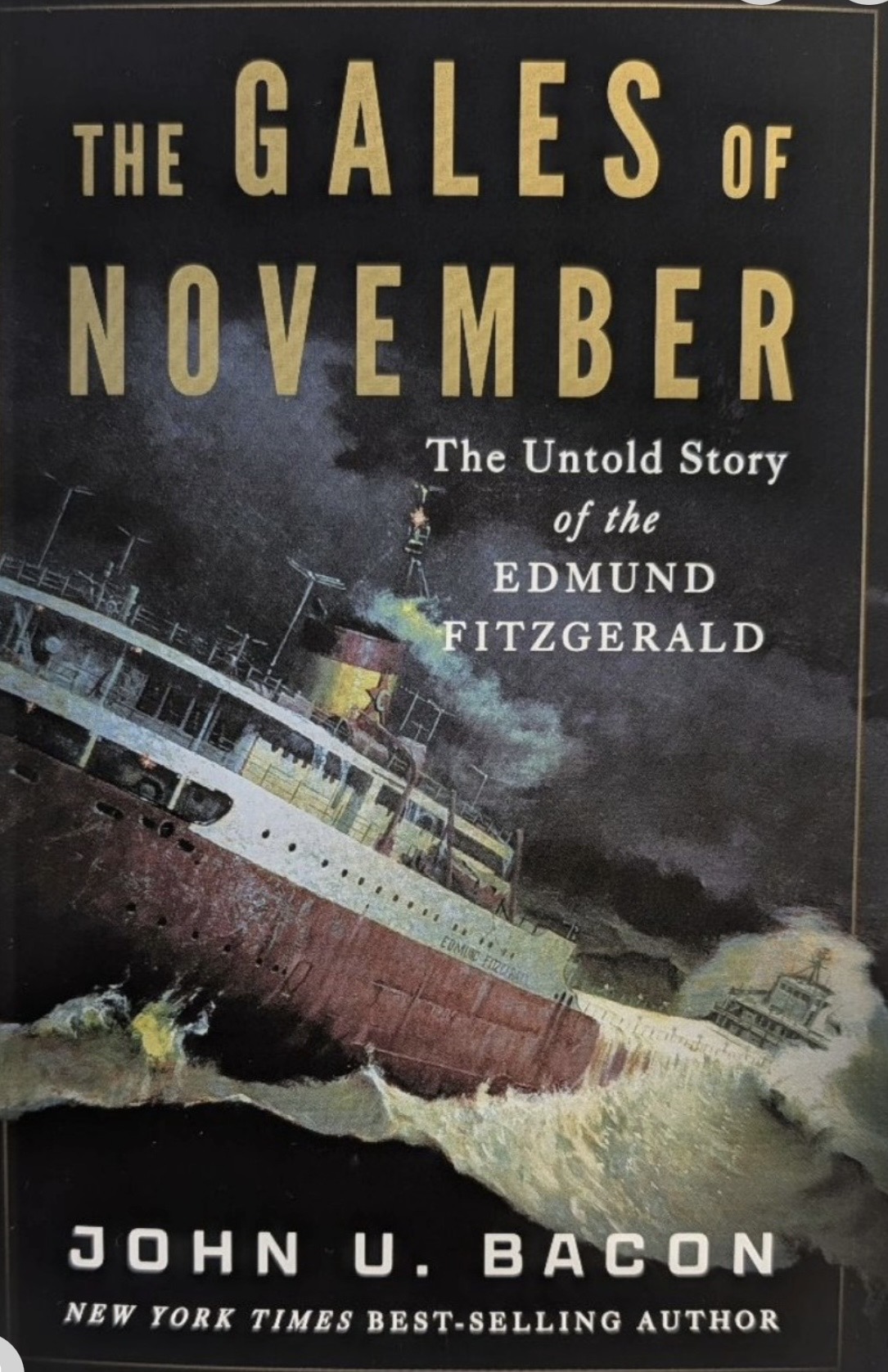
THE GALES OF NOVEMBER: The Untold Story of the Edmund Fitzgerald. By John U. Bacon. Liveright. 464 pages. $34, hardcover. Also available as audiobook, read by Johnny Heller. Recorded Books. 10 hours, 53 minutes.
Over the past four centuries, more than 30,000 commercial sailors have died in shipwrecks on the Great Lakes. That one of those losses, that of the November 10, 1975, sinking of the Edmund Fitzgerald, continues to generate popular interest is due to two main reasons.
The Edmund Fitzgerald was the pride of the Great Lakes fleet. At one time or another, often all at once, the freighter held the records for fastest passages from Superior, Wis., to Zug Island (Detroit), Mich., or Toledo, Ohio, and largest loads for individual trips and season-long. It was widely considered to have the Lakes’ best captain, Ernest M. McSorley, and best crew.
For that reason, and the human cost of 29 lives, the loss of the ship caught international attention, including that of Ontario folk singer Gordon Lightfoot, a recreational sailor himself. In 1976, he released “The Wreck of the Edmund Fitzgerald,” a song that is still popular today.
To mark the 50th anniversary of the ship’s sinking in Lake Superior a few miles off Whitefish Point in Michigan’s Upper Peninsula, John U. Bacon wrote The Gales of November. It is a comprehensive and compelling history of not only the ship’s loss but also of the whole Great Lakes shipping culture and commerce, topics of considerable importance today due to President Donald Trump’s moronic trade war with our Canadian cousins.
As well as I can imagine anyone doing, Bacon explains the physics of riding waves in the Great Lakes as opposed to doing so on an ocean or sea. The short distance between giant lake waves can create stress that can break a freighter carrying millions of pounds of taconite in half, especially if the ship was overloaded or if it had added the unwanted weight of lake water seeping into the cargo holds, apparently what happened to the Edmund Fitzgerald.
When the freighter left port on Nov. 9 for what was scheduled to be the final cruise for both McSorley and a good number of his veteran hands about to retire, the weather was perfect. The captain had an inkling that some bad weather was approaching in the form of an Alberta Clipper snowstorm, but certainly not anything to concern men who had decades of experience in the harsh conditions of Great Lakes’ waters.
What McSorley did not realize, because of weather forecasting limits 51 years ago, was that a storm coming out the American southwest was roaring toward him. The term “a perfect storm” was coined by author Sebastian Junger in his 1997 book, The Perfect Storm, for a 1991 storm that hit off the coast of New England and the Canadian Maritimes. The term could just as easily have been coined for what the Edmund Fitzgerald encountered.
By the time the ship goes down, the reader has learned a great deal about the lives of each of the crew and about life in general for Great Lakes sailors, how they behaved on board, how they behaved in port. Sailors were welcome in harbor bars, for example, but they were expected to follow a code of conduct that did not disrupt the lives of the locals.
As someone who grew up in a harbor town on Long Island Sound, I especially enjoyed Bacon’s reporting that the 1972 pop song “Brandy (You’re a Fine Girl)” by Looking Glass was the most popular play on port city juke boxes. Everyone in my town associated it with my cousin and boyhood best friend, Joey Cuomo. Finally, a blue-eyed blonde named Linda did, however, win his heart away from the sea to get him to the altar. The following day Joey was back in his boat, or along the shores of MacKenzie’s Point, fishing.
Bacon is a superb storyteller, making the reader truly feel the sadness of the crew’s loss and the struggles of those left behind. In addition, the book offers a superb economic lesson on the contributions of Great Lakes shipping to the American economy.
I listened to the audiobook and found Johnny Heller a capable reader.
Someday, I hope to visit the Upper Peninsula and The Great Lakes Shipwreck Museum, which, coincidentally, is in Whitefish Point. Many years after the ship’s loss, its bell was retrieved. It is displayed at the museum now.
- Paul T. O’Connor is a retired journalist and author ofThe Missing Child: The Life She Lived and The Life She Missed.