Note to readers: Paul O’Connor did not use AI to write this review, and I did not use AI to edit it. Paul did read a book written by a woman who spent a year letting AI nearly take over her life, and he’s using his own intelligence to tell you what he thinks about it.
I AM NOT A ROBOT: My Year Using AI To Do Almost Everything. By Joanna Stern. Harper. 277 pages. $32.
Reviewed by Paul T. O’Connor
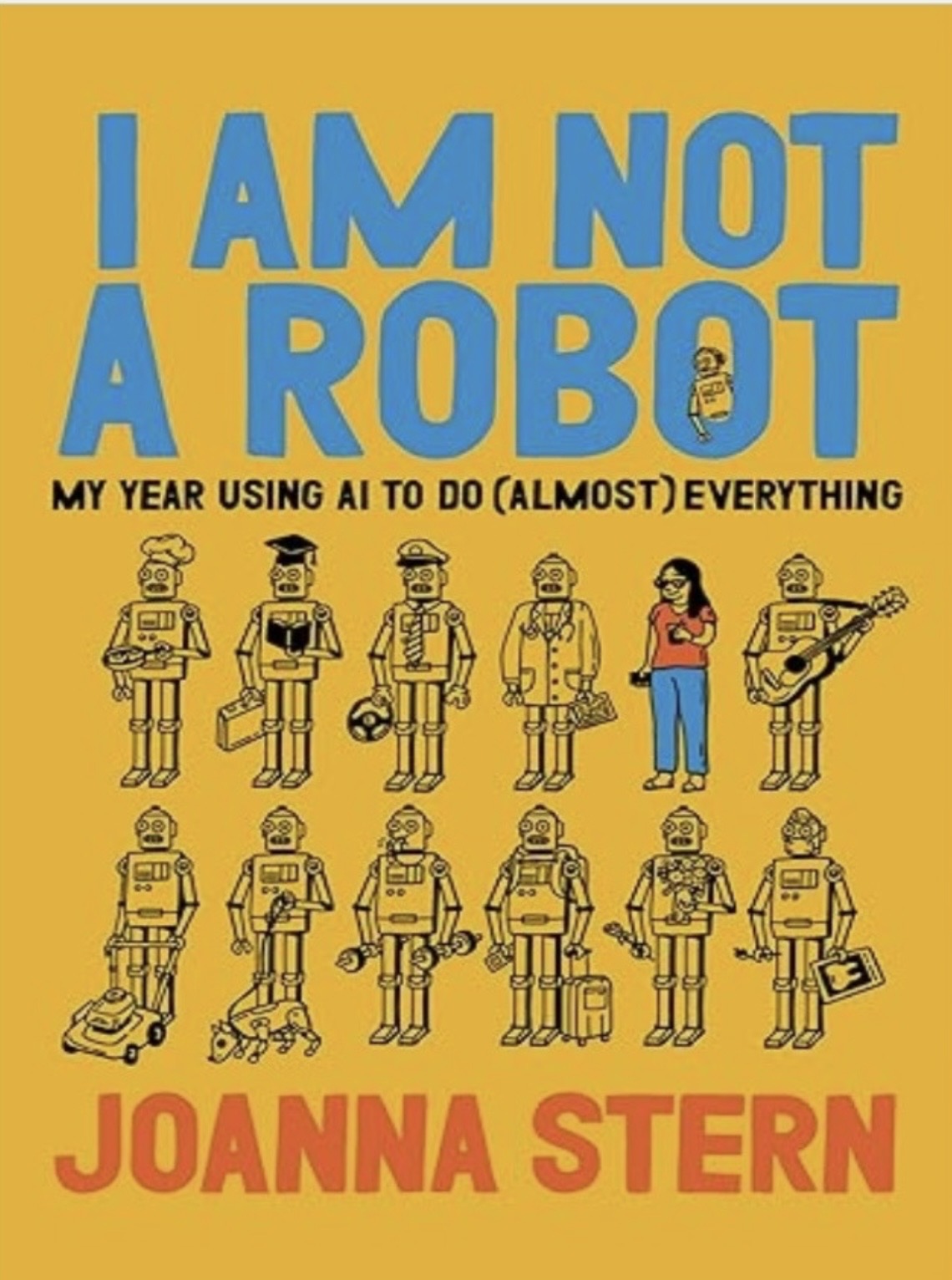
Most of us do everything we can to avoid artificial intelligence. Joanna Stern spent a year embracing it, turning to AI for as many chores as she could, all in an effort to explain, in her new book, the reality of the technology today.
In the year she spent as the guinea pig for I Am Not a Robot, Stern turned to AI for her mammograms, her dental exams, her vacation transportation, for artificial companionship, for therapy and for editing – but not for the writing – of her book. Combine her findings with her wit, and this is a surprisingly fun read.
One almost universally held opinion is that AI will be very helpful to health care, and Stern demonstrates how with her mammograms. Her family has a history of breast cancer, and she reveals that her breasts are particularly dense. Therefore, doctors looking at her mammograms might not spot problems as early as needed. They didn’t with her mother.
But AI-evaluated scans can spot dangerous growths far sooner than can the human eyes of even the best doctors. Additionally, when AI absorbs a great deal of data, as it does from a single scan, it can recognize data patterns that were previously unknown. This combination of advantages is leading the breast cancer doctors she interviewed to praise the value of AI. The technology will save lives, they say.
That’s not the case with dentists, Stern says. Anyone who has ever sat in the chair and had a hygienist or dentist pitch expensive new procedures will not be happy to learn that this dental up-selling is now being aided and abetted by AI. Her new dentist pulled up an AI analysis that recommended thousands of dollars of service that, when she checked with several other dentists, she learned was unnecessary.
Stern experiments with AI bots that serve as counsellors and friends. In both cases, she also interviews people who have used AI extensively for social company and counseling. Her reviews are mixed, but she warns, as many others do, that AI bots in these situations are very much programmed to make their clients happy. They are not necessarily candid.
Then came the weeklong vacation in Phoenix during which she and her family got around exclusively using AI driverless cars. It went well. Whether such cars will do as well in cities with less predictable weather is another question, however.
And she visits laboratories where robots are trying to be household servants. We have a long way to go before we get to Rosie of The Jetsons fame, she concludes. But, when she brought an AI robot dog into the house, her son quickly got attached.
My favorite chapter involved her experiment with an AI robotic massage therapist. There definitely are advantages, she decides, but don’t expect her to drop her human therapist. My massage therapist chuckled nervously when I told her about it.
Stern is making the podcast and radio talk show circuit, and her interviews led me to check the book out of my library. I’m glad I did. I got a better understanding of AI, how different kinds of AI work and of their potential for both good and bad.
Plus, I enjoyed her snark.
- Paul T. O’Connor is a retired journalist and author ofThe Missing Child: The Life She Lived and The Life She Missed.