Did you ever have the pleasure of reading Jane Austen’s novels? Although I was an English major in college, journalism courses accounted for many of my English hours. Otherwise, I took the usual Chaucer, Shakespeare, Milton, etc., and then studied as much American literature as I could.
It was a few years later, when I was older and maybe a bit wiser, that I bought a paperback collection of Austen’s novels. By then, I knew this English woman wrote in the early 19th century, that she was what was then called a “spinster,” with all that word implied, and that her books were published anonymously during her lifetime. Why, I wondered, have they become such classics, so well read today, and the inspiration for many movies and TV series?
I loved that collection, reading through the six novels one after the other,, enjoying every minute. Here was a woman who chose to turn her back on the expectations for someone of her sex and class and devote herself to writing instead. And what wonderful books – good stories that deftly employ understated satire and humor to show what life was really like in that sector of society, especially for women.
One of my other great reading loves is mysteries, mostly of the sort broadly called “cozy” that dwell not on the death and violence but on interactions among the people involved, especially those who set out to determine who the villain is.
So – how could I resist reading A Very Vexing Murder by Lucy Andrew, an English literature scholar, rabid Jane Austen fan and, now, a mystery writer?
Reviewed by Linda C. Brinson
A VERY VEXING MURDER. By Lucy Andrew. William Morrow. 415 pages. $30.
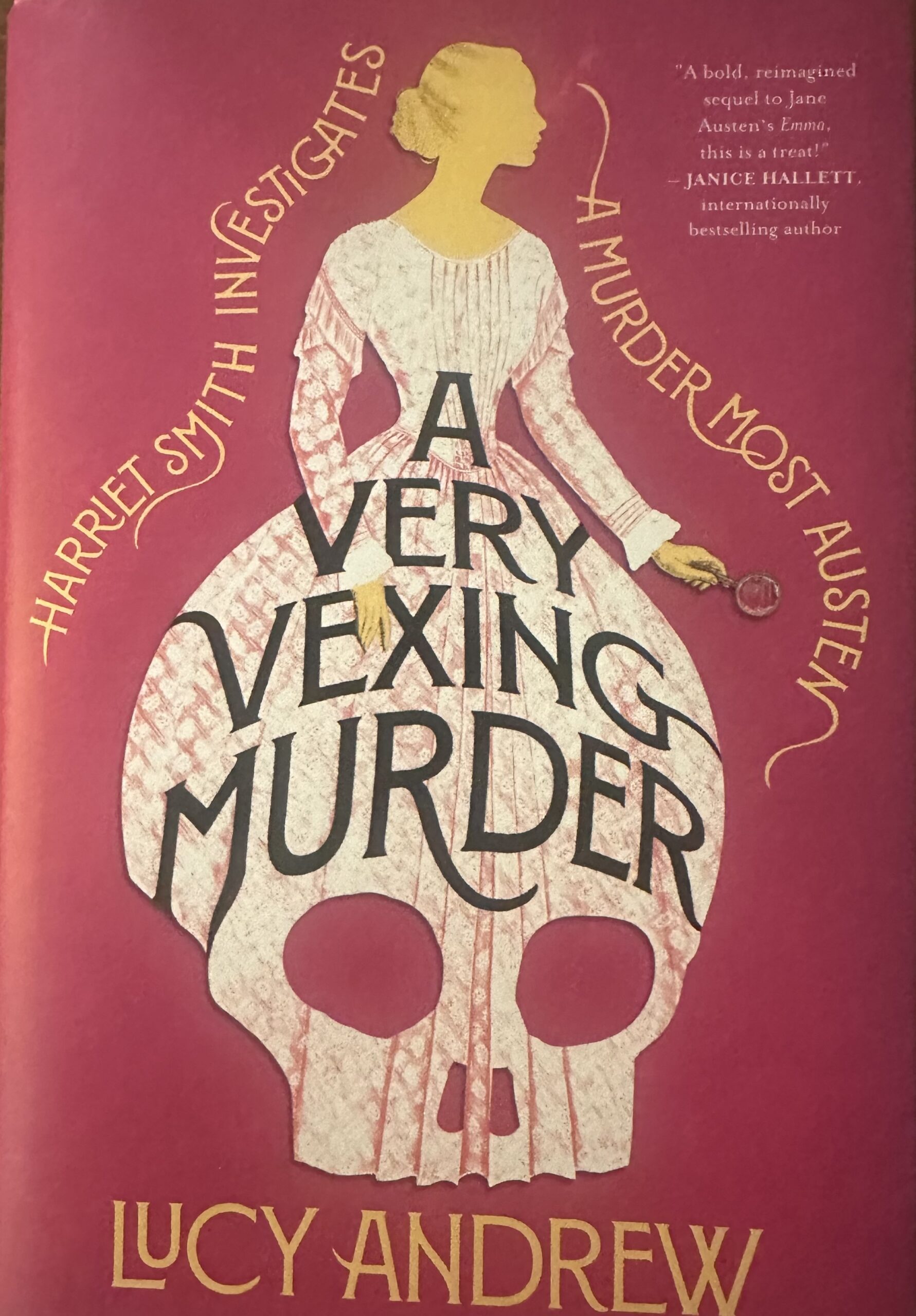 Those who have read Jane Austen’s novel Emma should recall Harriet Smith, a young woman, possibly the illegitimate child of a man with some means, who is being raised and educated in a boarding school. The bossy, meddling Emma Wodehouse takes Harriet on as a project, determined to teach her upper-class manners and help her make a “good” marriage.
In this retelling, Harriet knows who her father is: He’s the con man who has used her in some of his schemes. Now Harriet has broken away from him and is making her way in life as a detective, using the con woman skills she has learned when they serve her purposes.
Harriet has been hired by Mrs. Churchill to break off the engagement of her nephew, Frank Churchill. Mrs. Churchill is sure someone – most likely Frank’s unsuitable secret fiancée, Jane Fairfax – is out to kill her, and she wants Harriet to find out what’s going on in that regard too.
While not taking Mrs. Churchill’s suspicions too seriously, Harriet is more than happy to take her money.
Once she starts her investigations in the village of Highbury, however, Harriet begins to realize there is quite a lot going on, things that present real dangers not only to Mrs. Churchill, but to herself. To add to the suspense, Harriet also has reason to believe that the father she has left is out to get revenge.
Emma Wodehouse, the Churchills, Jane Fairfax and other characters from Austen’s novel have major roles in this version. So does Robert Martin, the young local farmer who is a love interest of Harriet’s in Austen’s novel, and a good friend (and maybe more?) in Andrew’s.
Lucy Andrew has done a brilliant job of blending portrayal of Regency society in Austen’s novel with the sometimes dangerous investigations of a lively, daring, independent young female detective who could almost have stepped out of the 21st century.
This book is a delight to read. The characters are interesting, and we gain additional insights into Regency society, ones that Jane Austen no doubt would have applauded. The plot, clever and believable, has plenty of twists, turns and action.
Harriet Smith, I hope, has more investigations and adventures awaiting her in future novels.