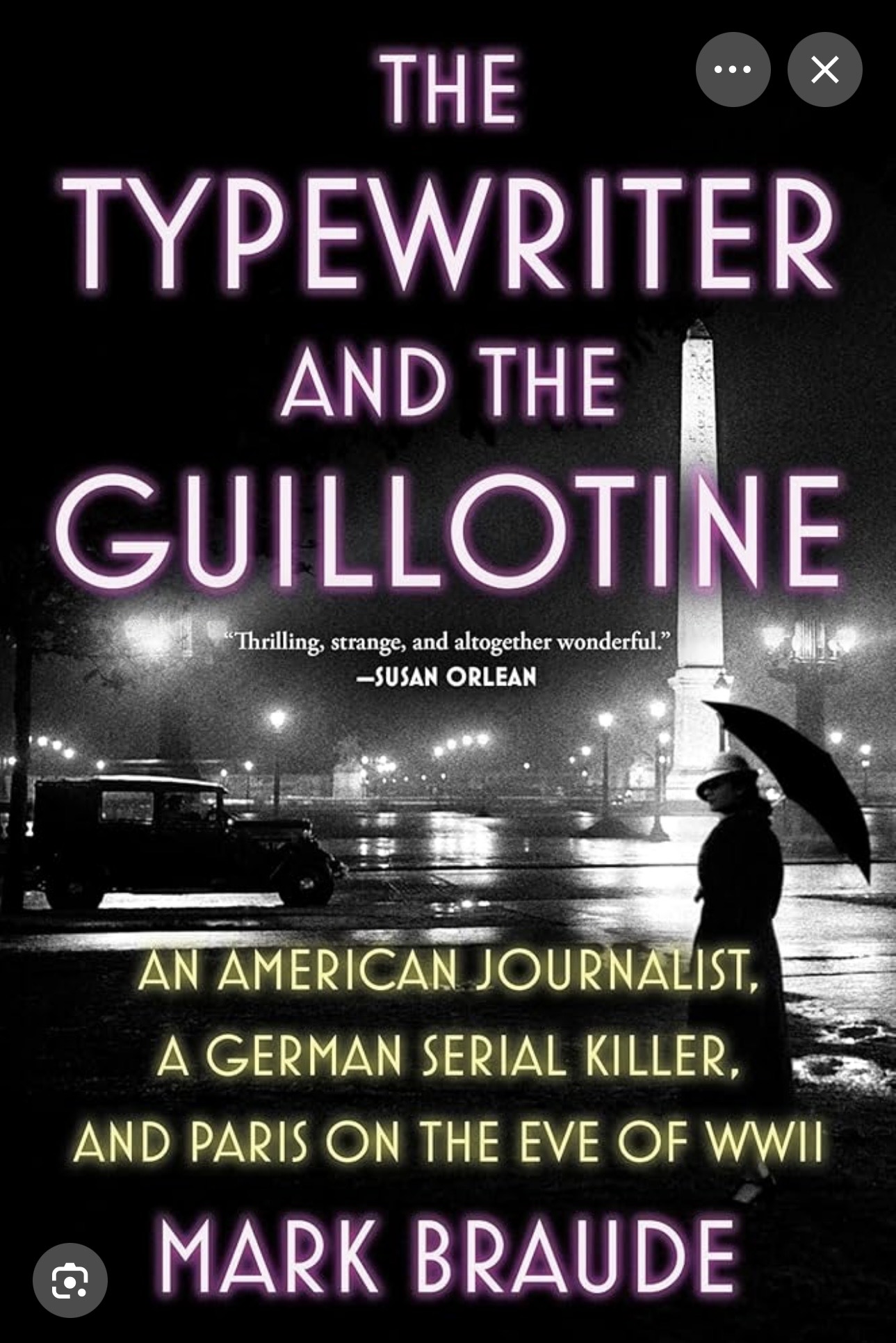
Paul O’Connor, soon to join the ranks of published authors of nonfiction books, reviews a recent nonfiction work that combines biography, journalism, history, crime, politics and more. He finds it well worth reading.
Reviewed by Paul T. O’Connor
THE TYPEWRITER AND THE GUILLOTINE: AN AMERICAN JOURNALIST, A GERMAN SERIAL KILLER, AND PARIS ON THE EVE OF WWII. By Mark Braude. Grand Central Publishing. 346 pages. $32.50, hardcover.
France’s fall to the Nazis in the spring of 1940 may have shocked the world, but not American journalist Janet Flanner.
She had been writing a regular letter from Paris for The New Yorker magazine since 1925, and over that time had witnessed France’s steady deterioration. Throughout the 1930s, the city endured frequent street violence perpetrated by political factions ranging from fascists to communists and many shades in between. The Paris of gaiety and hope that the young Flanner had long known had disappeared by 1939, the first year of the European war.
In its place came despondency, political paralysis and economic disaster. French national cohesion was dead.
In Germany, a madman was growing, and author Mark Braude is not referring to Adolf Hitler in this case. Eugen Weidmann was developing from a problem child to a con man and thief and, after he got to Paris, to a mass murderer.
In The Typewriter and the Guillotine, Baude uses the same two-track story organization that Erik Larson achieved in The Devil in the White City. Baude doesn’t reach that lofty target, however, as Flanner’s life and story consume the great majority of this book’s pages. The reader is well beyond the book’s midpoint before Weidmann’s chapters stretch for anything more than a few pages.
Nonetheless, Baude has provided us with an engaging and informative look at the city – and the country – on the eve of its 1940 collapse.
Flanner was an accidental find for the newly launched magazine. From Paris, where she was living while trying to develop as a fiction writer, she regularly wrote personal letters to friend Jane Grant, a New York journalist. Grant was married to Harold Ross, who was starting the magazine. Ross also read the letters and, with Grant’s agreement, hired Flanner as his Paris freelancer. She was to regularly write letters about the city’s social and cultural life.
Baude takes us through Flanner’s personal and professional trials and into the early 1930s, where European political developments drag her away from her preferred topics of music, art and theater and into politics.
Weidmann, on the other hand, is becoming a man of pure evil. By the time he is released from a German prison and heads to Paris, he is determined to be a professional criminal. That’s the path that leads to his eventual murder of six and then to his end on the guillotine.
The two stories merge only when the story of the six murders, and the pursuit of the culprit, consumes the French media in early 1939 and Flanner covers the story.
Both stories are interesting, but Flanner’s reputation as one of the great American journalists of her generation was not built around her writing about Weidmann. Her stories about Hitler, the Nazis, Paris in the 1930s and then the Nuremberg trials are her greatest achievements.
No one interested in American journalism or Paris in that era should let my nitpicking on that point keep them from reading this book. Well written and quite informative, The Typewriter and the Guillotine is a very worthwhile read.
- Paul T. O’Connor’s first book, The Missing Child: The Life She Lived and the Life She Missed, will be published on May 26 by Torchflame Books.