Paul O’Connor takes a look at one of the top-ranked books of 2025 – the story of the 1929 stock market crash and the Great Depression that resulted – and finds it’s well worth the investment of your reading time (pun intended) (sorry, Paul).
Reviewed by Paul T. O’Connor
1929: INSIDE THE GREATEST CRASH IN HISTORY AND HOW IT SHATTERED A NATION. By Andrew Ross Sorkin. Penguin Publishing. 592 pages. $30, hardcover. Also available in audiobook from Penguin Audio, read by the author, 13 hours and 30 minutes.
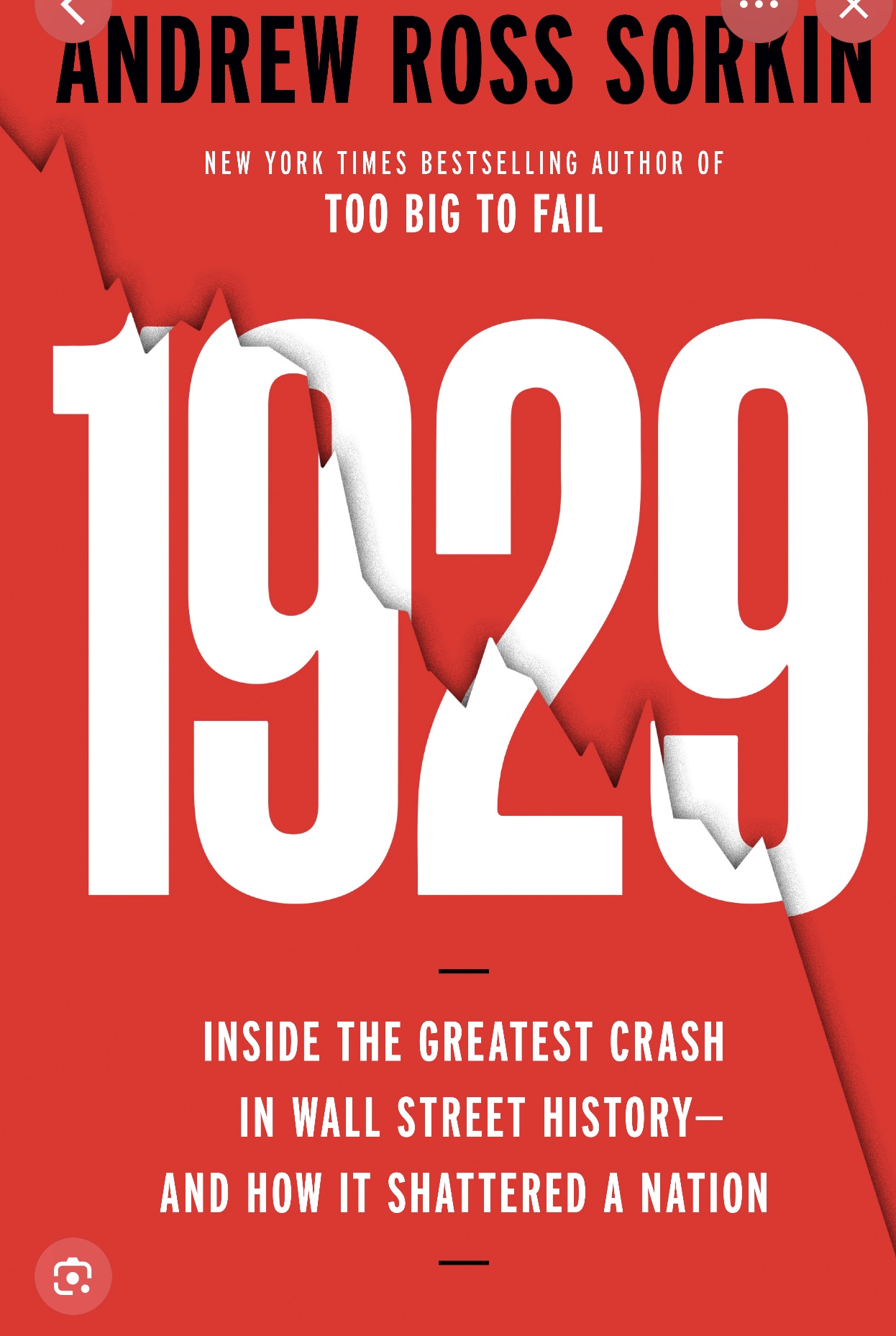
In 1929: Inside the Greatest Crash in History and How it Shattered a Nation, Andrew Ross Sorkin explains how the stock market crashed in terms simple enough for most of us to understand. That is why it is on every “Best Books of 2025” list I’ve seen in the last month.
People buy stocks for two essential reasons: to invest or to gamble. In 1929, the New York stock imploded because too many people were gambling.
And they weren’t necessarily gambling with their own money. Often, they were gambling with money they had borrowed using what are known as “margin loans” or with money that others had deposited in the banks they owned or operated. The investors and gamblers weren’t limited to people with disposable cash: Many working-class people were pouring their savings into get-rich-quick schemes.
All of this speculation drove prices higher by the day and, when stock prices became unsustainable, the market went poof!
As stock prices dropped, banks began to call in “margin loans,” the collateral for which was the very stock portfolio bought with the loan. When investors then had to sell the stocks to pay the loan, they only further drove down the price of the stock, thereby creating more calls on margin loans.
To explain this crash and how it contributed to the decade-long Great Depression, Sorkin goes back to earlier market panics, especially that of 1907. In those days, a relatively small number of investors could disrupt the markets, and a relatively few bankers could rescue them. J.P. Morgan did just that in 1907.
In 1929, the prolonged rally of the “Roarin’ 20s,” however, meant that far greater numbers were invested in the continuing bull market and no consortium of bankers could stem the drop.
The Oct. 29, 1929, crash did not come as a complete surprise. Many market bears were warning of the detrimental implications of a raging market driven by speculation. Some people were getting rich picking just the right time to “short” the markets, basically betting that a particular stock was about to drop.
But few experts were predicting just how dire the crash would be. To the contrary, some important leaders thought a “correction” in market prices – a common adjustment in which stock prices drop to more supportable levels – would be good for the nation, having no serious effect on the overall economy.
The Depression came because it destroyed the credit markets essential to a modern economy. Any entity needing credit to operate – from the family farm to the automaker – found the credit market dry. Without credit, they could not plant the crops or pay workers to assemble cars. Many lost the farm itself, and small-town banks failed by the hundreds.
Readers should know that this book does not dive deeply into the other causes of the Depression, particularly the financial crisis in rural America, which had been depressed for much of the 1920s. When the dust storms began in 1930, it only deepened the crisis for an economy that was far more reliant on agriculture than it is now.
The story ends with popular anger leading to both congressional and criminal investigations of the banking titans at the center of the crash. The thirst for retribution was strong.
That thirst did lead to important reforms. The Glass-Steagall Act of 1933 separated commercial banking, our checking and savings accounts, from investment banking. And it created the Federal Deposit Insurance Corporation, which today protects consumer accounts in the event of bank failures.
Sorkin’s book deserves all the praise it has received. It’s not only informative, but it’s also readable and interesting. Sorkin narrates the audiobook, employing the speaking skills he’s developed on financial TV shows.
- Paul T. O’Connor is a retired journalist and journalism professor whose first book, The Missing Child, will be published early next year by Torchflame Books. He holds dual American and Irish citizenship.