Men walking on the moon was just a beginning. Here’s your chance to learn about today’s space race, as earthlings compete to colonize the moon, and maybe, someday, Mars.
Reviewed by Paul T. O’Connor
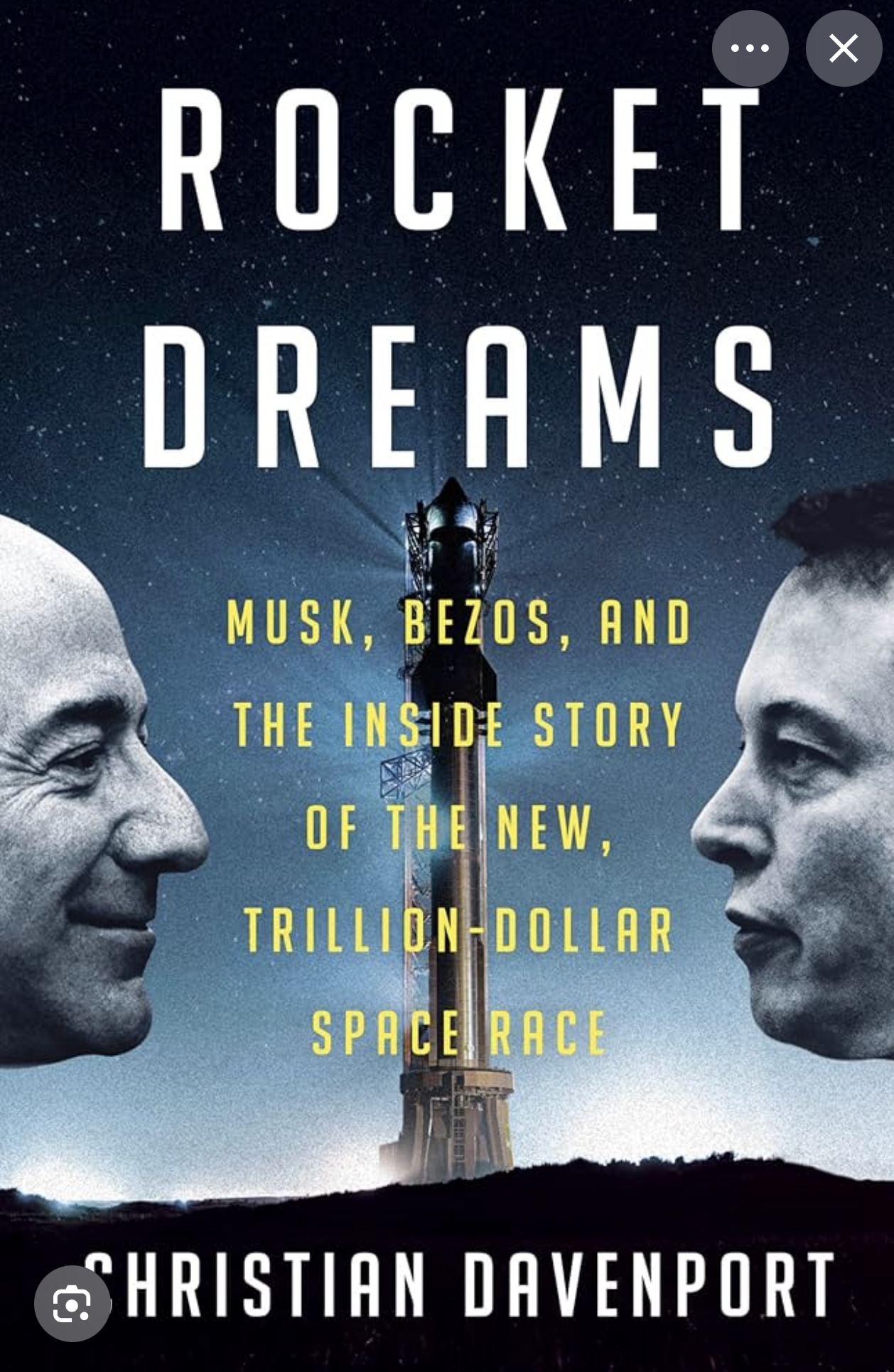
ROCKET DREAMS: MUSK, BEZOS AND THE INSIDE STORY OF THE NEW, TRILLION-DOLLAR SPACE RACE. By Christian Davenport. Crown Currency Publishing Co. 327 pages. $32, hardcover.
For those around in the 1960s, “space race” referred to the contest between the United States and the Soviet Union to be the first to land men on the moon.
That term has a new meaning today, however, as Christian Davenport expertly details in his new book, Rocket Dreams.
The current race is twofold. One is between the U.S., China, Russia, and maybe India, Japan and the European Union to militarize space and possibly dominate life on earth.
The other is within the U.S., as Elon Musk’s Space X, Jeff Bezos’s Blue Origin and more traditional aerospace firms compete to provide the machines that NASA needs to colonize the moon (and later Mars) and the weapons the military needs to protect American interests.
As the book’s title indicates, Davenport spends more of his words on the Musk-Bezos race, although the military race is well detailed.
As much as we might dislike Bezos and Musk, it will fall mostly on their shoulders, and to some degree from their wallets, to lead the U.S. to provide the equipment to first reach the moon and Mars and to later colonize them.
Davenport, who covers the space program for The Washington Post, methodically synthesizes the path NASA has taken over the past 25 years. The U.S. abandoned manned missions into deep space decades ago and focused instead on the orbiting space station and deep-space robotic probes.
Unfortunately, long-term planning for deep-space exploration with manned crews was left to NASA’s traditional partners. These aerospace contractors were wedded to outdated engineering concepts and beholden to the appropriating powers in Congress, who were concerned more with preserving jobs in their districts than with actually accomplishing the necessary breakthroughs.
That’s where Musk and, to a lesser extent, Bezos came along. They first began to develop new rocket and vehicle designs and then, after showing success privately, they sold themselves to NASA.
Rocket Dreams is mostly a detailed chronology of the progress and setbacks the two experienced as they raced against each other and battled with the laws of physics.
For those of us who do not read science fiction or futuristic space novels, Davenport’s reporting on the ideas for how people would colonize distant moons and planets, and how they would sustain themselves with on-site resources, is probably the most fascinating aspect of the book.
Humans will land on the moon, tap its water to create rocket fuel, tap its minerals to create living structures, and source their energy needs from the sun. Humans will mine the moon for resources needed back on earth and for those needed to get humans to Mars.
Davenport has given us a concise and hopeful look at the next space race, the race to move onto other celestial bodies and live there.