Paul O’Connor finds that this 2023 nonfiction book ranks right up there with the best of thrillers.
Reviewed by Paul T. O’Connor
THERE WILL BE FIRE: Margaret Thatcher, the IRA, and Two Minutes That Changed History. By Rory Carroll. G.P. Putnam & Sons. 416 pages. $30, hardcover. Also available from Penguin Audio, read by John Keating. 14 hours, 6 minutes.
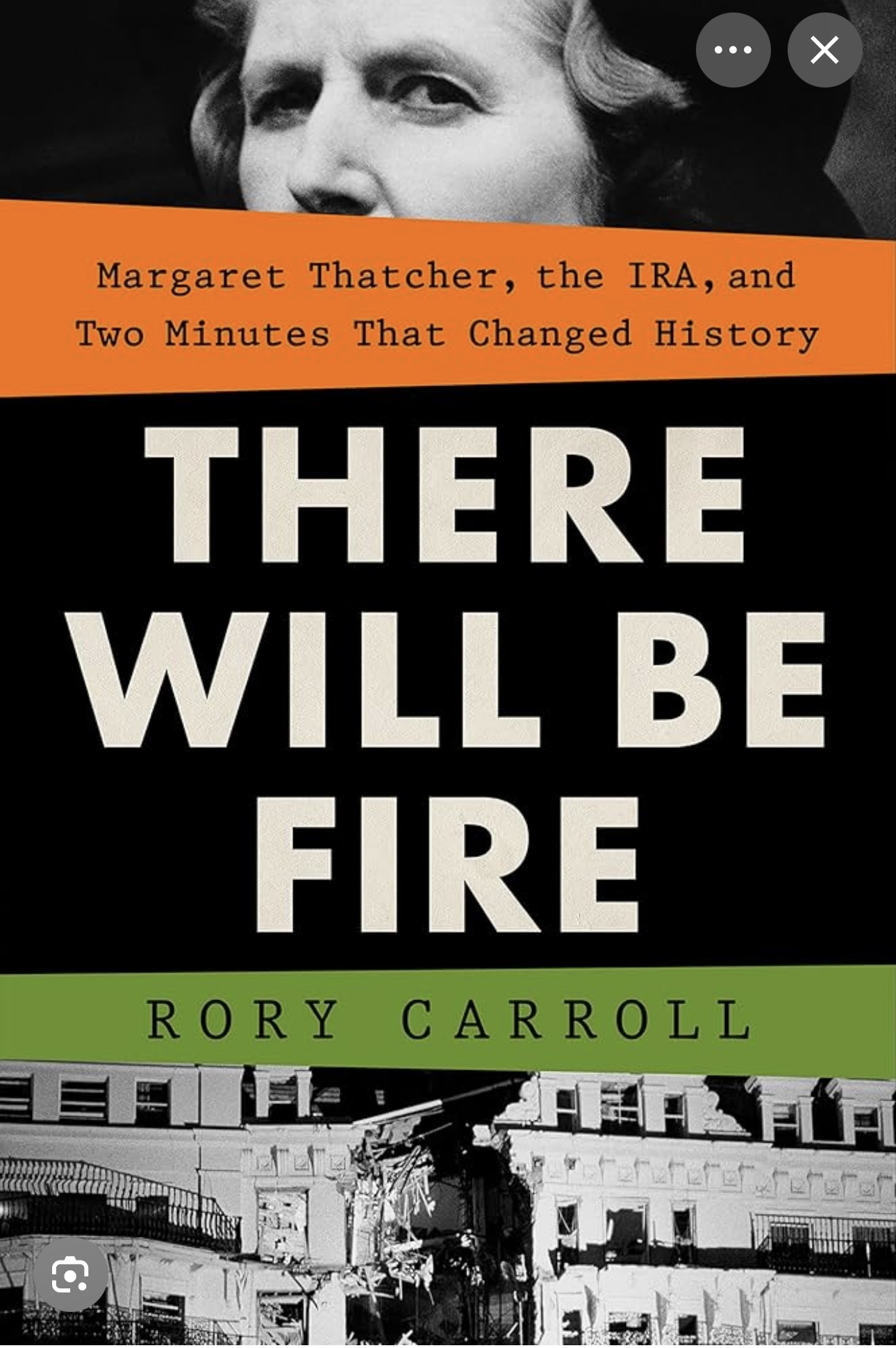
Is a thriller still a thriller if the reader knows the outcome before opening the first page?
Was Frederick Forsyth’s Day of the Jackal a thriller despite every reader’s knowing, beforehand, that the Jackal never assassinated Charles DeGaulle?
The answer to both questions is, “Of course!” With most thrillers, we know the outcome ahead of time. The good guy wins, vanquishes evil and survives for the book’s sequel. Does anyone really think that Daniel Silva will ever kill off Gabriel Allon, his meal ticket?
It’s widely known that the Irish Republican Army failed to assassinate Margaret Thatcher, the British prime minister, at the Grand Hotel in Brighton, England, on Oct. 12, 1984. And we know from the start that the Brits eventually capture the lead bomber, Patrick Magee. But Rory Carroll’s nonfiction, There Will Be Fire, is as thrilling as any fiction mystery writers conjure up because it is the process of the attempt and the process of the investigation that are so thrilling.
The Irish journalist Carroll, using a full range of published material and original research, tracks Magee’s journey from Belfast birth, through childhood years in England, and then up through the IRA’s ranks in Northern Ireland.
Magee was known to the British as “the Chancer” on the mistaken belief that he took unnecessary chances to achieve his goals. But Carroll details how Magee meticulously planned his operations, leaving nothing to chance.
Typical British bias against all Irish only helps Magee. He and his colleagues are repeatedly underestimated, in part because of self-inflicted wounds, what the British call “the Paddy effect.” But the IRA learns from each mistake, and the culmination of all their knowledge learned from trial and error is the near successful operation against Thatcher. The bomb goes off, kills five people associated with Britain’s Conservative Party and injures many more. Had Thatcher stayed in her hotel room bathroom for just two more minutes, she might have been the sixth.
As the IRA so chillingly commented in claiming responsibility for the bombing, “Today we were unlucky, but remember we have only to be lucky once, you will have to be lucky always.”
Equally meticulous are the British investigators, who in the pre-digital age had to inspect the tiny leads left behind by hand. The prolonged search for the identity of the bomber and then the extensive search for Magee once he was identified are a beginner’s course in the science of criminal forensics circa 1985.
Carroll’s work has a few curiosities to it. The first is that he leaves unchallenged Thatcher’s post-explosion bombast about the IRA’s failure to destroy British democracy. What a joke! The British democracy of which she boasts had been suppressing Ireland for 700 years, and in 1984 still brutally repressed the Catholic population of Northern Ireland.
And, as other reviewers have noted, Carroll is extraordinarily generous to Thatcher in his assessment of her role in positive events after 1985.
Nonetheless, this is a fabulous book, a thrilling crime read even if his politics strike me as having been conceived through orange-colored glasses.
Penguin Audio’s audiobook is expertly read by John Keating.
- Paul T. O’Connor is a retired journalist and journalism professor whose first book, The Missing Child, will be published early next year by Torchflame Books. He holds dual American and Irish citizenship.